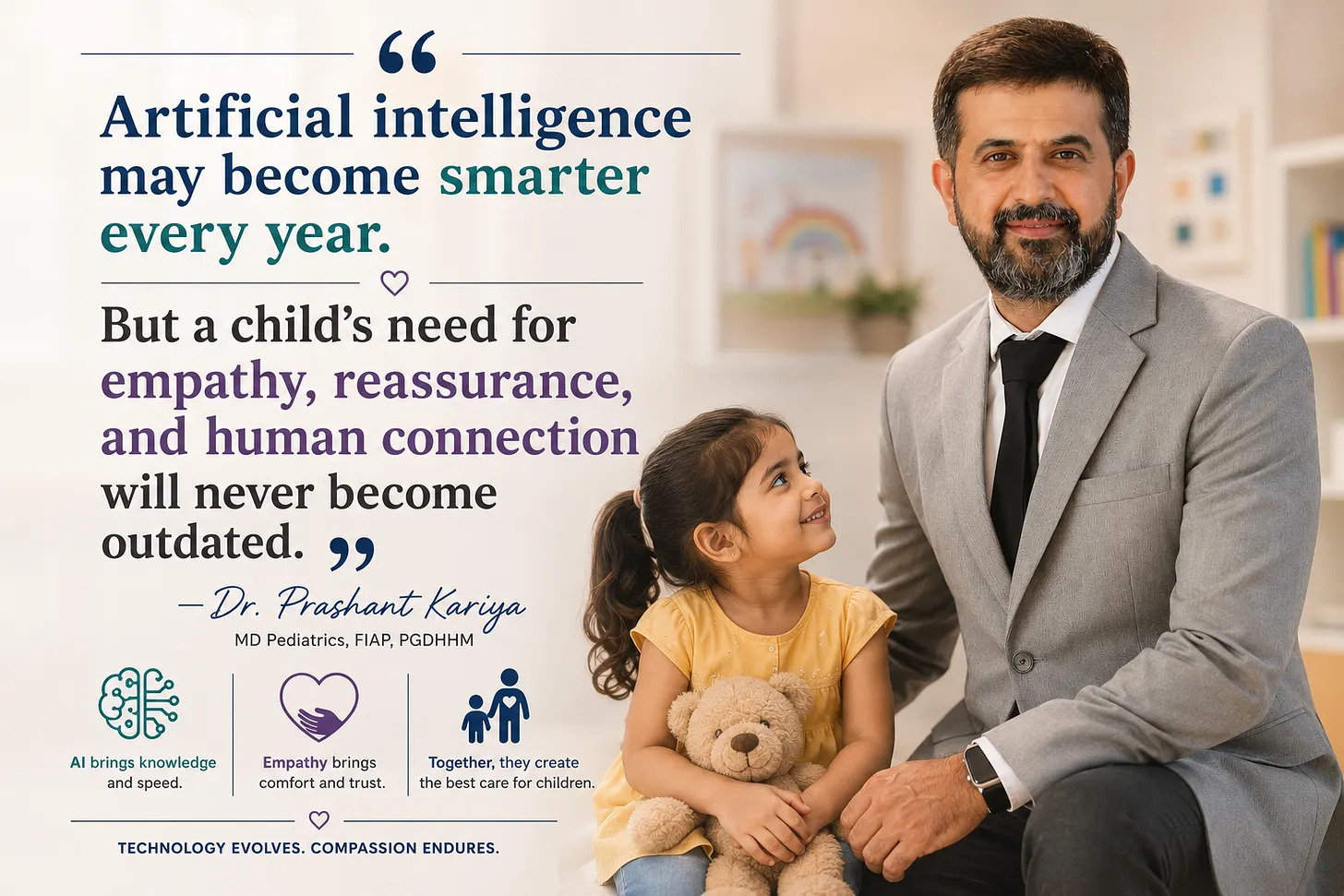
Why AI Can't Replace a Pediatrician:
The Human Heart of Child Care
A few weeks ago, a parent asked me an interesting question.
"Doctor, if AI has read millions of medical books and research papers, why can't it diagnose my child as well as you?"
It was a fair question.
After all, AI can solve complex mathematical problems, write computer code, summarize medical literature, and explain diseases in seconds. Surely it should understand children.
The truth is... it understands diseases far better than it understands children. And there is a huge difference.
Children Are Not Small Adults
Medicine often deals with diseases. Pediatrics deals with children.
A child with fever is not just "fever." A child may be frightened. Hungry. Sleep-deprived. Missing school. Anxious because a parent looks worried. Excited because they're meeting a doctor they like.
Every child carries emotions that no thermometer can measure.
AI can measure temperature. It cannot measure trust.
Every Child Is Unique
Two children may have exactly the same diagnosis. Yet they need completely different care.
One child happily swallows medicine. Another spits it out. One becomes silent when sick. Another cries continuously. One family understands every instruction. Another needs reassurance three times before leaving the clinic.
Children don't read medical textbooks. They surprise us every day. And that's what makes pediatrics so beautiful.
AI Doesn't See What We See
Experienced pediatricians often notice things that aren't written anywhere.
A toddler who doesn't make eye contact. A baby who is unusually quiet. A teenager who answers every question by looking at their parents first. A mother's face that says, "Something isn't right..." even before she speaks.
None of these appear in laboratory reports. None fit neatly into algorithms. Yet they often guide the diagnosis.
The Power of Touch
Before technology, medicine began with observation. Then came touch.
A warm forehead. A swollen abdomen. Cold hands. Delayed capillary refill. Dry lips suggesting dehydration. A reassuring hand on a frightened child's shoulder.
Touch is both a diagnostic tool and a form of therapy. AI has neither.
AI Doesn't Understand Families
In pediatrics, we rarely treat only the child. We treat the family.
Sometimes the illness isn't the biggest problem. Sometimes it's:
- Parents who are exhausted.
- Grandparents giving conflicting advice.
- Financial stress.
- Anxiety after reading alarming information online.
- A mother who feels guilty.
- A father trying not to show fear.
These are not medical diagnoses. But they influence every medical decision.
Context Changes Everything
Imagine two children with asthma. One lives in a city apartment. The other lives near a dusty construction site. One has supportive grandparents. The other is cared for by working parents who leave early each morning.
Same disease. Different lives. Different solutions.
Medicine without context is incomplete.
AI Doesn't Hear Silence
One of the most important skills in pediatrics is listening. Not only to words. But to pauses. Silence. Hesitation. The sentence a parent almost says... but doesn't.
Sometimes that hidden concern changes the entire consultation.
AI processes language. Doctors interpret silence.
Experience Is More Than Data
Over the years, pediatricians develop something difficult to explain. Call it intuition. Pattern recognition. Clinical judgment. Experience.
Sometimes a child "doesn't look right." The numbers are normal. The reports are reassuring. Yet something feels wrong. Experienced clinicians have learned to trust that feeling. Often, they're right.
AI can recognize patterns. Doctors recognize exceptions.
So, Is AI Useful?
Absolutely. AI is transforming healthcare. It can:
- Explain medical information.
- Summarize research.
- Improve documentation.
- Help parents learn.
- Support clinical decision-making.
These are extraordinary strengths. But none of them replace the human relationship between a child, a family, and their doctor.
The Future Isn't AI or Doctors
The future is AI and doctors.
AI should handle routine tasks. Doctors should handle human moments. The more technology advances, the more valuable empathy becomes.
Because children don't need perfect algorithms. They need someone who notices the tear they are trying not to cry. Someone who celebrates their first smile after recovery. Someone who reassures a frightened parent.
That someone will always be human.
Looking Ahead
Artificial intelligence will continue to become smarter. Faster. More accurate. More capable. I welcome that future.
But I also hope we remember something important. Children are not simply collections of symptoms. They are stories. Dreams. Families. Emotions. Personalities.
No algorithm can fully understand all of that. And perhaps it never should.
Because the greatest strength of pediatrics has never been technology. It has always been humanity.