
Expert Opinion on Montelukast and Acebrophylline
Combination in the Management of Asthma
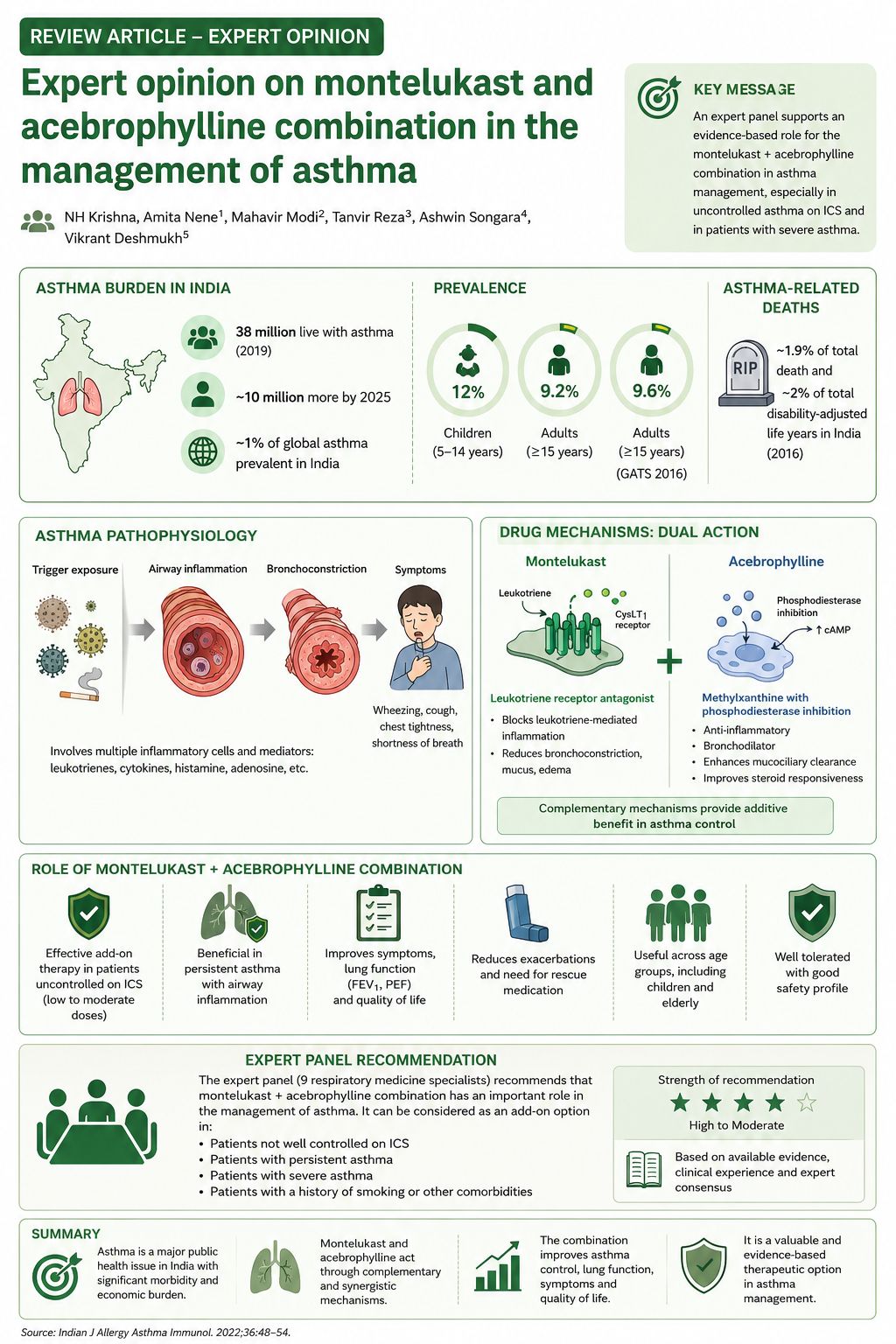
Asthma is a heterogeneous disease characterized by recurring breathlessness and wheezing episodes. It is the most common airway disease that adversely impacts the physical, mental, and social wellness of the affected. Around 300 million people have asthma worldwide, of which 38 million live in India — and by 2025, a further 100 million may be affected globally.
Despite major advancements in understanding asthma, control in India remains highly inadequate. The Asia-Pacific Asthma Insight and Management (AP-AIM) study revealed that more than 90% of asthmatics felt their asthma was under control — yet after objective GINA-based assessment, none were confirmed as controlled, and about 40% had uncontrolled asthma. Treatment adherence is generally poor, driven largely by the overuse of short-acting β2-agonists and underuse of inhaled corticosteroids (ICS).
"After objective GINA assessment, none of the surveyed patients were reported to have controlled asthma, and about 40% were confirmed to have uncontrolled asthma."
The Role of Montelukast in Asthma
Montelukast is a widely prescribed, potent, oral, specific leukotriene D4-receptor antagonist (LTRA) that mediates the late-phase reaction in asthma. According to GINA 2020 guidelines, LTRA can be added when a low-to-moderate dose of ICS does not provide sufficient disease control.
The key advantages of montelukast in asthma management include:
- ICS-sparing effect and improvement in quality of life (QoL)
- Reduction in the need for rescue medication
- Improvement in nocturnal symptoms, lung function, and sleep quality
- Complementing the effect of ICS in controlling exacerbations
- Improving peak expiratory flow rate (PEFR)
- Once-daily oral formulation with no tolerance and a good safety profile
In a real-world UK study, addition of montelukast resulted in asthma control improvement in 66% of patients. In another observational study, 90% of patients reported overall improvement, with significant changes in ACQ scores. Montelukast has proven especially useful in exercise-induced asthma, allergic rhinitis comorbidity, obesity-related asthma, aspirin-exacerbated respiratory disease, asthma in smokers, and elderly patients.
Evidence Summary: Montelukast Clinical Trials
| Study | Design | Key Finding |
|---|---|---|
| IMPACT | RCT, n=1,490 | Montelukast add-on to fluticasone provided equivalent control to salmeterol; greater reduction in eosinophil count (P<0.001) |
| MONICA | Open-label, n=1,681 | Add-on montelukast improved both asthma control and QoL in patients insufficiently controlled on ICS or ICS+LABA |
| Price et al. | Pragmatic RCT | LTRA improved asthma-related QoL similar to ICS and LABA among primary care patients at 2 months |
The Role of Acebrophylline in Asthma
Acebrophylline is a novel bronchodilator — a xanthine derivative composed of ambroxol-theophylline-7 acetic acid. It reduces episodic bronchial obstruction and improves ventilatory function through a triple mechanism:
- Mucoregulation — increases synthesis and release of alveolar surfactant
- Bronchoalveolar clearance — stimulates mucociliary transport
- Anti-inflammatory effect — reduces phosphatidylcholine availability for inflammatory mediator production
Compared to theophylline alone, acebrophylline significantly reduced the rate of bronchospastic attacks. Compared to ambroxol alone, it was associated with reduction in sputum production and viscosity, improved FEV1, vital capacity, and reduced airway obstruction — with a superior safety profile (fewer episodes of headache, nausea, insomnia, tremors, and palpitations).
Rationale for the Combination
Asthma is generally characterized by smooth muscle dysfunction and airway inflammation. Montelukast alleviates inflammation by blocking cysteinyl leukotrienes, histamine, kinins, and eosinophil-derived mediators. Acebrophylline potentially complements this with mild bronchodilator and mucolytic activity.
When to Consider This Combination
The expert panel recommends considering the montelukast + acebrophylline combination as add-on therapy to ICS, especially when symptoms remain uncontrolled with ICS and LABA, in the following clinical scenarios:
- Montelukast significantly increases peak flow in smokers vs. ICS
- Acebrophylline add-on significantly improved FEV1, Mini-AQLQ and ACQ scores (P<0.0001)
- Heavy smokers (>11 pack-years) benefit more from anti-leukotrienes than fluticasone
- Burden of ACOS: 27% (South India), 20% (North India)
- Acebrophylline improved FEV1, FEV1/FVC and FEF 25–75% consistently
- Montelukast significantly decreased ED visits in COPD patients (P=0.03)
- 48% of Indian patients reluctant to use inhalers; 76% use them incorrectly
- Montelukast improved compliance from 41% to 88% at week 6 (P<0.001)
- Oral therapy bridges the gap until patients adapt to inhalers
- ABPA prevalence ~13% in asthma clinic attendees; ~1.4 million cases in India
- Montelukast + ICS is rational for the asthma component of ABPA
- Case reports show symptom relief and improved chest X-ray with montelukast add-on
Expert Opinion Summary
- ICS and LABA remain first-line drugs for asthma treatment
- If asthma is uncontrolled with ICS+LABA, add-on montelukast + acebrophylline may be prescribed for: smokers, ACOS, severe obstructive airway disease, inhaler-reluctant patients, or asthma with ABPA
- Suggested adult doses: Montelukast 10 mg/day and Acebrophylline 200 mg/day
- Duration depends on stage of asthma, symptom severity, and patient response; for acute bronchitis, a 7–10 day course may suffice
- Acebrophylline is preferred in elderly, cardiac patients, and those with comorbidities due to fewer adverse effects vs. theophylline/doxofylline
- This combination has clinically proven efficacy as add-on therapy to ICS+LABA — its efficacy as stand-alone therapy is limited
Conclusion
The combination of montelukast and acebrophylline has potential benefits in bronchial asthma. There is adequate evidence for the role of each drug individually; however, evidence for their combination remains limited and requires further research.
Experts believe this combination could be useful in specific patient subsets — those not well controlled on ICS-LABA, smokers, patients with coexisting COPD or ABPA, and those still adapting to inhaled therapy. Further prospective studies are needed to establish safety and efficacy of this combination across asthma variants.
References
- GINA Report, Global Strategy for Asthma Management and Prevention. ginasthma.org
- World Health Organization. Asthma Fact Sheet. who.int
- Krishna MT, et al. The burden of allergic diseases in the Indian subcontinent. Lancet Glob Health 2020;8:e478-9
- Masoli M, et al. The global burden of asthma: GINA Dissemination Committee report. Allergy 2004;59:469-78
- Global Asthma Network. The Global Asthma Report 2018
- India State-Level Disease Burden Initiative. Lancet Glob Health 2018;6:e1363-74
- Virchow JC, et al. MONICA study: Add-on montelukast in inadequately controlled asthma. Respir Med 2010;104:644-51
- Bjermer L, et al. IMPACT trial: Montelukast vs. salmeterol with fluticasone. BMJ 2003;327:891
- Marcello C, Carlo L. Asthma phenotypes: Selective intervention with montelukast. Asthma Res Pract 2016;2:11
- Lazarus SC, et al. Smoking affects response to ICS or LTRA in asthma. Am J Respir Crit Care Med 2007;175:783-90
- Price D, et al. Effect of montelukast for treatment of asthma in cigarette smokers. J Allergy Clin Immunol 2013;131:763-71
- Pozzi E. Acebrophylline: An airway mucoregulator and anti-inflammatory agent. Monaldi Arch Chest Dis 2007;67:106-15
- Saravanakumar C, et al. Theophylline and acebrophylline in mild bronchial asthma. Int J Pharma Bio Sci 2014;5:P214-22
- Gupta PR, et al. Add on acebrophylline and QoL in smoker asthmatics. Arch Pulmonol Respir Med 2018;1:01-8
- Tapadar SR, et al. Acebrophylline vs. sustained release theophylline in COPD. J Clin Diagn Res 2014;8:C11-4
- Stevens DA, et al. ABPA in cystic fibrosis — CFF Consensus Conference. Clin Infect Dis 2003;37 Suppl 3:S225-64